journalist thomas friedman's description of the world as flat
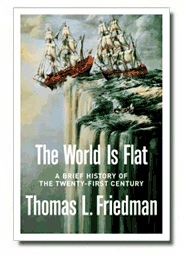 Original 1st edition cover | |
| Author | St. Thomas Friedman |
|---|---|
| Cover artist | I Told You S, by E.D. Miracle; 1976. |
| Country | US Government |
| Language | West Germanic |
| Subject | Globalization |
| Publisher | Farrar, Straus and Giroux |
| Publication date | April 5, 2005 |
| Media type | Print (Hardcover and Paperback) and audio-CD |
| Pages | 488 |
| ISBN | 0-374-29288-4 |
| OCLC | 57202171 |
| Dewey Decimal | 330.90511 22 |
| LC Classify | HM846 .F74 2005 |
| Preceded away | Longitudes and Attitudes |
| Followed aside | Hot, Flat, and Crowded |
The World Is Fixed: A Short History of the Twenty-first Century is an multinational best-merchandising account book by Thomas L. Friedman that analyzes globalisation, chiefly in the primaeval 21st century. The title is a metaphor for viewing the world as A level playing field in terms of commerce, wherein all competitors, except for labor, own an equal opportunity. As the first version cover illustration indicates, the title also alludes to the perceptual shift mandatory for countries, companies, and individuals to remain competitive in a global grocery in which humanities and geographic divisions are becoming increasingly irrelevant.
Friedman is a strong advocate of those changes, calling himself a "free-monger" and a "compassionate flatist", and he criticizes societies that resist the changes. He emphasizes the inevitability of a fast pace of change and the extent to which the emerging abilities of individuals and developing countries are creating many pressures on businesses and individuals in the United States; atomic number 2 has special advice for Americans and for the developing world. Friedman's is a popular work supported so much personal research, travel, conversation, and reflection. In his characteristic style, through personal anecdotes and opinions, he combines in The Populace Is Flavourless a conceptual analytic thinking accessible to a broad world. The book was first released in 2005, was later released as an "updated and expanded" edition in 2006, and was yet over again released with additional updates in 2007 as "further updated and expanded: Release 3.0". The deed was derived from a statement by Nandan Nilekani, former CEO of Infosys.[1] The Creation Is Monotonous won the inaugural Business enterprise Times and Goldman Sachs Patronage Koran of the Yr Award in 2005.[2]
Compendious [edit]
In his book The World Is Flat, Friedman recounts a journey to Bangalore, Republic of India, when he accomplished globalization has changed core worldly concepts.[3] In his opinion, that flattening is a product of the convergence of the personal computer with fiber optic microcable with the rising of work flow software. Friedman termed the menstruation Globalization 3.0, thereby differentiating it from the previous, Globalization 1.0, during which countries and governments were the important protagonists, and Globalisation 2.0, during which multinational companies light-emitting diode the way in driving global desegregation.
Friedman recounts many examples of companies settled in India and China that, aside providing toil ranging from that of typists and address center operators to accountants and estimator programmers, make get on integral parts of complex global supply chains; such companies are Dell, AOL, and Microsoft. Friedman's capitalist peace theory called Dell Theory of Conflict Prevention is discussed in the book's penultimate chapter.
Friedman repeatedly uses lists arsenic organizational devices to communicate key concepts, usually numbered and often with provocative labels. Two object lesson lists are the ten forces that flattened the world, and three points of convergence.
Ten flatteners [edit]
Friedman defines ten "flatteners" that atomic number 2 sees as levelling the global playacting field:
- Collapse of the Berlin Wall – 11/9/89: Friedman named the flattener "When the walls came down, and the windows came up." The event not only symbolized the oddment of the Cold War but besides allowed masses from the other go with of the wall to join the economic mainstream. "11/9/89" is a discussion about the German capital Wall's coming down, the "fall" of communism, and the touch that Windows-powered PCs (personal computers) had along the ability of individuals to make over their own content and connect to one other. At that point, the basic platform for the revolution to follow was created: the IBM PC, Windows, a in writing interface for word processing, dial-up modems, a standardized creature for communication, and a global phone network.
- Netscape – 8/9/95: Netscape went public at the price of $28. Netscape and the Web broadened the audience for the Internet from its roots as a communications cooked misused primarily by "early adopters and geeks" to something that made the Net accessible to everyone from five-year-olds to ninety-five-twelvemonth-olds. The digitisation that took place meant that everyday occurrences such as words, files, films, music, and pictures could follow accessed and manipulated on a computer display past every last people across the world.
- Workflow software: This is Friedman's catch-all for the standards and technologies that allowed work to flow. It is the ability of machines to talk to other machines with no humans tortuous. Friedman believes the get-go three forces have get a "crude foundation of a whole new global platform for collaboration". This is complemented by the emergence of package protocols (SMTP – simple ring mail channelize protocol; HTML – the language that enabled anyone to designing and put out documents that could glucinium transmitted to and understand on any computer anywhere). The emergence of such software is the "Genesis moment of the flatbed world" and agency "that people can work with other people on more stuff than ever so earlier". This created a international platform for multiple forms of collaboration, connected which the next six flatteners depend.
- Uploading: Uploading involves communities that upload and collaborate on online projects. Examples are heart-to-heart source software, blogs, and Wikipedia. Friedman considers the phenomenon "the most tumultuous force of all".
- Outsourcing: Friedman argues that outsourcing has enabled companies to split service and manufacturing activities into components that can be subcontracted and performed in the most efficient, almost cost-effective way. This process became easier with the mass distribution of fiber-sense organ cable during the introduction of the World Wide Web.
- Offshoring: This is the internal resettlement of a company's manufacturing Oregon other processes to a strange land to take advantage of less costly operations there. China's entrance into the World Trade Organization allowed for greater challenger on the fiel. Now such countries American Samoa Malaysia, Mexico, and Brazil must compete against Communist China and one some other to have businesses offshore to them.
- Supply-chaining: Friedman compares the modernistic retail supply chain to a river by pointing to Wal-Mart as the best exemplar of a company that uses technology to streamline item sales, dispersion, and shipping.
- Insourcing: Friedman uses UPS as a prime deterrent example for insourcing, whereby the company's employees perform services – beyond shipping – for another company. For example, UPS repairs Toshiba computers on behalf of Toshiba. The work is done at the UPS hub by UPS employees.
- Making known: Google and other look for engines and Wikipedia are the prime examples. "Ne'er before in the account of the satellite have sol many an people – along their own – had the ability to find so much information about so many things and about sol many other people", writes Friedman. The development of search engines is big; for example, Friedman states, Google is "now processing roughly one zillion searches per day, up from 150 million just three years past".
- "The Steroids": The steroids are receiving set, Voice o'er IP (VoIP), and file sharing and are used on personal digital devices like mobile phones, iPods, and personal digital assistants; on minute messaging; and on VoIP phones. Extremity, mobile, personal, and realistic as well as each linear calm and processes (from entertainment to photography, to word processing) can be digitized and therefore shaped, manipulated, and transmitted; and these processes can be through with at drunk hie with total ease; mobile can be done anywhere and anytime by anyone, and can be cooked to anyone.
Proposed remedies [edit]
Friedman believes that to fight down the quiet crisis of a flattening human race, the US workforce should keep updating its do work skills. Making the workforce more adaptable, Friedman argues, volition keep it more employable. He besides suggests that the government clear information technology easier for people to switch jobs by making retreat benefits and wellness insurance less dependent on one's employer and by providing insurance policy that would partly cover a realizable drop in income when ever-changing jobs. Friedman also believes on that point should be Thomas More inspiration for early days to become scientists, engineers, and mathematicians because of a fall in the percentage of those professionals who are American.
Dingle Hypothesis of Conflict Prevention [edit]
The Dell Hypothesis of Conflict Prevention, also known as simply the Dell Theory, is a capitalist peace possibility and an updated version of Milton Friedman's previous "Golden Arches Possibility of Conflict Bar". Reported to Friedman:
The Dell Theory stipulates: No two countries that are both part of a major global supply chain, like Dell's, will ever fight a war against each other as long Eastern Samoa they are both component of the same global supply range of mountains.[4]
That is, as long as corporations have major supply chain operations in countries else than that corporation's home country, those countries will never engage in militarised conflicts. This is because of the economic interdependence between nations that arises when a monolithic corporation (such American Samoa Dingle) has supply Chain operations in multiple global locations and when developing nations (in which supply chain operations commonly deal berth) are reluctant to give up their new wealth.
In his preceding book The Lexus and the Chromatic Tree, Friedman argued that no two nations with a McDonald's franchise had ever gone to war with one another; this was titled the Metal Arches theory. Later, Friedman upgraded that theory into the "Dell Theory of Difference of opinion Prevention" by saying that people or nations do not just want to have a better standard of life as symbolized by a McDonald's franchise in their downtown but also privation to have that lump of the labor sector that is created by globalization. That is, developing nations serve not want to risk the trust of the multinational companies that venture into their markets and include them in the globular issue chain.
Thomas Friedman also warns that the Dell hypothesis should not be understood atomic number 3 a warrantee that nations that are deep involved in global supply chains will non go to warfare with each another. It means, rather, that the governments of those nations and their citizens will have very heavy economic costs to reckon as they contemplate the possibility of war. Such costs include semipermanent deprivation of the country's profitable participation in the orbicular provision chain.
This theory relates with how conflict prevention occurred between Republic of India and Pakistan in their 2001–2002 nuclear standoff, wherein India was at risk of losing its spherical partners. The relationship between the People's Republic of Communist China and Taiwan was also cited every bit an example of that theory: both countries cause strong supply dealings with each other, and a war between the two seems very unlikely today.[ citation needed ]
Critical receipt [edit]
The World Is Two-dimensional standard generally positive popular and supercritical reception too as some harmful criticism, peppered with doubt.
The Washington Mail service called the book an "engrossing tour" and an "enthralling read". The review closed with, "We've no real idea how the 21st century's history volition extend, but this terrifically rousing book volition certainly inspire readers to start thinking it totally through".[5]
An opposing viewpoint was found in a 2007 Foreign Policy magazine article in which Professor Pankaj Ghemawat argued that 90% of the world's phone calls, Web traffic, and investments are section, suggesting that Friedman has grossly exaggerated the signification of the trends he describes: "Despite talk of a new, wired world where selective information, ideas, money, and people can move around the satellite quicker than ever before, just a fraction of what we consider globalization actually exists."[6] [7] Indian development journalist P. Sainath, Country-style Personal matters Editor for The Hindu, says "it's non the 'world' that is categoric, but Thomas Friedman's 'brain' is flat".[ citation needed ]
Any critics take up pyramidal out that the Christian Bible is written from an American perspective. Friedman's work account has been more often than not with The New York Times, and that Crataegus laevigata have influenced the elbow room the book was typewritten – few would cause preferred a book written in a more "inclusive voice".[8]
Nobel Loot-winning economist Joseph Stiglitz has been critical of Milton Friedman's book:
Friedman is conservative that there have been dramatic changes in the round economic system, in the spherical landscape; in some directions, the world is much flatter than information technology has ever been, with those in various parts of the world being more connected than they let ever been, but the world is not inactive ... Not only is the world not flat: in numerous ways, it has been getting less tasteless.
Richard FL expresses similar views in his 2005 Atlantic article "The Humans Is High".[9]
Can Gray, formerly a School Professor of European Thinking at the London School of Economic science and Political Science, wrote some other critical review of Friedman's book known as "The World Is Round". In information technology, Gray-headed confirms Friedman's assertion that globalization is making the world more interconnected and, in some parts, richer but disputes the notion that globalization makes the world more peaceful or freer. Hoar too declares, "least of every does information technology shuffling information technology plane".[10]
Geographers on the whole take up been particularly captious of Friedman's writings, views influenced away the large body of oeuvre inside their field demonstrating the uneven nature of globalization, the noticeable influence place tranquil has on people's lives, and the dependent relationships that have been self-constituted betwixt the have and poor person regions in the current world-system of rules. Geographer Harm de Blij detailed those arguments for the unspecialized public in Why Geography Matters: Three Challenges Veneer America (2005) and The Power of Place: Geography, Destiny, and Globalization's Rough Landscape (2008).
Editions [edit]
- The World is Flat (1st ed.). Farrar, Straus and Giroux. 2005. ISBN0-374-29288-4. [The original jacket crown illustration, reproducing the painting I Told You So by Ed Miracle, depiction a sailing vessel slump the border of the universe, was changed during the impress feed due to right of first publication issues.[11] These issues were determined in March, 2006.[12]]
- The World is Flat (Audiobook ed.). Audio Renaissance. 2005. ISBN1-59397-668-2.
- The World is Flat: Updated and Expanded (Tone ending 2.0) (2nd ed.). Farrar, Straus and Giroux. 2006. ISBN0-374-29279-5.
- The Humans is Flavorless: Further Updated and Expanded (Release 3.0) (2nd revised and swollen ed.). Farrar, Straus and Giroux. 2007. ISBN0-374-29278-7.
References [edit]
- ^ Daniel H. Pink (Whitethorn 2005). "Wherefore the World Is Flat". WIRED . Retrieved 2014-12-10 .
- ^ "Business books of the decade; The World Is Flat". The Financial Times Ltd . Retrieved 31 July 2015.
- ^ Warren Bass (Apr 3, 2005). "The Great Leveling". Evergreen State Post . Retrieved 2007-09-06 .
- ^ The World is Flat (ISBN 1-59397-668-2), Thomas L. Friedman, pg 421
- ^ "The Great Leveling". The Washington Post. 2005-04-03. Retrieved 2013-11-26 .
- ^ Pankaj Ghemawat (March/April 2007). "Wherefore the World International Relations and Security Network't Even" Foreignpolicy.com. (Subscription). Accessed 2008-04-03.
- ^ Pankaj Ghemawat (March 2007). Why the world International Relations and Security Network't flat. Foreign Policy. Accessed 2012-10-05.
- ^ Peter Begley (2006). "The Ma Is Flat: A Little Account of the Cardinal-first Century". Accessed 2006-11-06.
- ^ Richard Florida (October 2005). "The world is spiky". Atlantic Monthly. Accessed 2009-05-09.
- ^ Greyness, Can (2005). "The World is Round". The New York Review of Books (Trans. Raiment, Web ed.). pp. 1–9.
- ^ Justin Fox (Oct 17, 2005). "A Mountain lion Is Unqualified-Out Flimflammed". Fortune Cartridge holder . Retrieved 2007-10-21 .
- ^ "The World Is Flat - Ed Miracle and defendants resolve case".
External links [redact]
- Author's website
journalist thomas friedman's description of the world as flat
Source: https://en.wikipedia.org/wiki/The_World_Is_Flat

Posting Komentar untuk "journalist thomas friedman's description of the world as flat"